SEO vs GEO: How to Get Your Website Cited by ChatGPT, Perplexity and Google AI Overviews
A year ago, getting found online meant one thing: rank on Google.
Now a growing share of your customers never see a list of ten blue links. They ask ChatGPT, Perplexity or Gemini, or they read the AI Overview at the top of Google, and they get one written answer that cites a handful of sources. If your site isn't one of those sources, you're not on the shortlist.
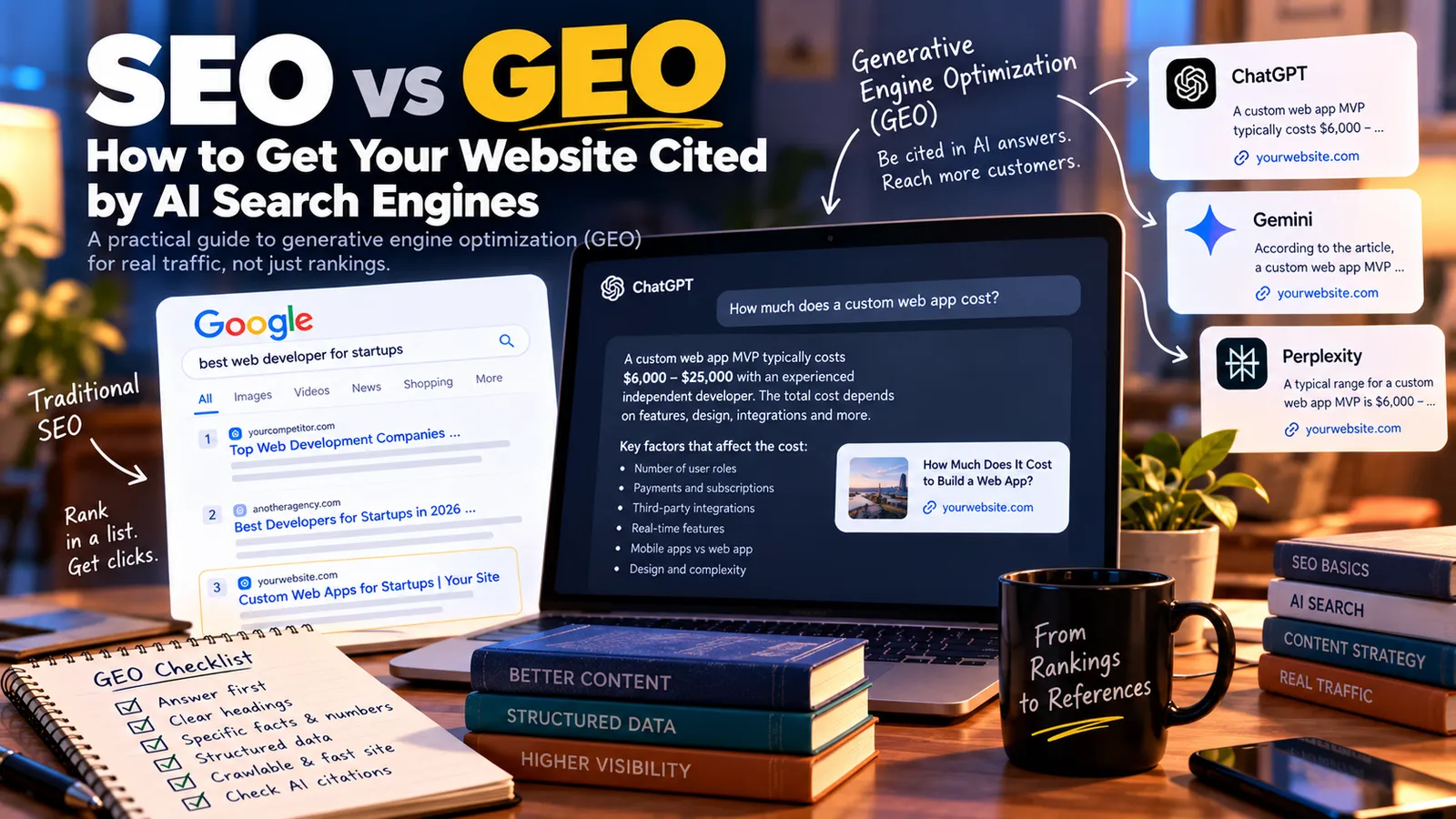
That's what GEO, generative engine optimization, is about. This post explains how it differs from traditional SEO, what actually gets a page cited by AI, and a practical checklist you can work through on your own site.
What's inside
- SEO vs GEO in one paragraph
- How AI search engines pick their sources
- What still matters from classic SEO
- 9 things that make a page more citable by AI
- llms.txt, AI crawlers and robots.txt
- How to check whether AI is citing you
- A one-week GEO checklist
- FAQ
SEO vs GEO in one paragraph
SEO gets your page ranked in a list of results so a person clicks it. GEO gets your page quoted inside an AI-generated answer, so the model names you, links you, or repeats your facts. SEO competes for a position; GEO competes for a citation. They share a foundation (a fast, crawlable, trustworthy site), but GEO puts more weight on how easily a machine can lift a clear, accurate answer out of your page.
| Classic SEO | GEO | |
|---|---|---|
| Goal | Rank in the results list | Be cited in the AI answer |
| Who reads your page first | A crawler, then a human | A crawler, then a language model, then maybe a human |
| What wins | Relevance, authority, links, UX | Clear answers, facts, structure, authority, freshness |
| Success metric | Rankings, clicks, traffic | Mentions, citations, referral visits from AI tools |
| Timeframe | Months | Similar, and sometimes faster for fresh content |
How AI search engines pick their sources
The details differ between ChatGPT search, Perplexity, Gemini and Google's AI Overviews, but the broad process is similar:
- The question is turned into searches. The system runs one or more web or index queries behind the scenes.
- Candidate pages are retrieved. Usually pages that already rank reasonably well in a search index for those queries.
- Passages are extracted. The model reads chunks of those pages, not the whole site.
- An answer is written and sources are attached. Pages whose passages directly support the answer get cited.
Two things follow from this:
- You still need to be in the index and reasonably well ranked. AI search sits on top of search, not instead of it.
- Individual passages matter. A page that buries its answer in paragraph nine is harder to quote than one that states it clearly near the top of a section.
If you would rather have this done for your site, here is how my SEO and GEO services work.
What still matters from classic SEO
GEO is not a replacement for the basics. If any of these are broken, nothing else in this post will help much:
- Crawlability and indexing. Pages must return proper status codes, be linked internally, appear in your sitemap, and not be blocked by
robots.txtornoindex. - Server-rendered HTML. If your content only appears after JavaScript runs, some crawlers will see an empty page. Pre-rendering or server-side rendering fixes this.
- Speed and Core Web Vitals. Fast pages are easier to crawl and better for the humans who do click through.
- Topical authority. A site with several connected pages on a subject is more trusted on that subject than a site with one isolated post.
- E-E-A-T signals. Real author names, credentials, an about page, contact details and evidence of first-hand experience.
9 things that make a page more citable by AI
1. Answer first, then explain
Start each section with a one or two sentence direct answer, then add the detail. Models (and readers) can lift that opening sentence as-is.
Bad: "There are many factors to consider when thinking about the cost of a web app…"
Good: "A custom web app MVP typically costs $6,000–$25,000 with an experienced independent developer. Here's what drives that range."
2. Use question-shaped headings
Write headings the way people ask: "How long does an MVP take to build?" rather than "Timeline considerations". They match the queries AI systems run.
3. Include specific, checkable facts
Numbers, dates, prices, limits and definitions are easier to quote than opinions. If you cite a statistic, name the source.
4. Define your terms clearly
A clean "X is…" sentence is one of the most commonly quoted patterns in AI answers. If you coined or rely on a term, define it once, plainly.
5. Use tables and lists for comparisons
Comparisons, steps and criteria are much easier to extract from a table or numbered list than from long paragraphs.
6. Add structured data
JSON-LD schema for Organization, Person, Article, FAQPage, Product or Service tells machines exactly what the page is about and who is behind it.
7. Keep it fresh and dated
Show a published date and an updated date, and actually update important pages. AI answers lean towards current information, especially for prices, tools and "best of" questions.
8. Be consistent about who you are across the web
Your name, business name, location and services should match on your site, Google Business Profile, LinkedIn, directories and social profiles. Consistent entity signals help models connect "this site" with "this business".
9. Earn mentions elsewhere
Models learn from and retrieve across the whole web. Being mentioned on relevant sites, communities, directories and in other people's articles makes you a more likely answer, the same way backlinks help SEO.
llms.txt, AI crawlers and robots.txt
Two practical, technical steps:
Check your robots.txt. AI crawlers identify themselves with user agents such as GPTBot and OAI-SearchBot (OpenAI), PerplexityBot, ClaudeBot (Anthropic) and Google-Extended (Google's AI training control). If you block them, you are much less likely to appear in their answers. Decide deliberately rather than inheriting a default.
Consider an llms.txt file. llms.txt is a proposed convention: a plain Markdown file at the root of your site that summarises what the site is and links to the most important pages, written for language models. It's not an official standard and not every system reads it, but it's cheap to add and forces you to articulate what your site is about in a few lines.
A minimal example:
# Build by Kashyap

> Full-stack developer (Angular, .NET) building web apps and MVPs for founders, plus SEO and GEO services.

## Services
- [Services and pricing](https://buildbykashyap.in/services): fixed-price web app MVPs, landing sites and retainers

## Writing
- [Blog](https://buildbykashyap.in/blog): engineering, self-hosting and AI-assisted development
How to check whether AI is citing you
There's no Search Console for ChatGPT yet, so measurement is a mix of methods:
- Prompt testing. Make a list of 10–20 questions your customers would ask. Run them monthly in ChatGPT, Perplexity, Gemini and Google, and record who gets cited.
- Referral traffic. In GA4 or your analytics tool, watch for visits from
chatgpt.com,perplexity.ai,gemini.google.comand similar domains. - Search Console. AI Overview impressions are included in your Google Search Console performance data, so rising impressions on question-style queries are a useful signal.
- Brand mentions. Search for your name and brand inside AI tools: what do they say about you, and is it accurate?
A one-week GEO checklist
If you want to start this week, do these in order:
- Day 1: Confirm your key pages are indexed in Google Search Console and not blocked in
robots.txt(including AI crawlers). - Day 2: Check that your pages render real content without JavaScript (view source, or use a text-only fetch).
- Day 3: Rewrite the opening of your three most important pages so they answer the main question in the first two sentences.
- Day 4: Add an FAQ section with question-shaped headings to your service or product page.
- Day 5: Add JSON-LD structured data for your organisation and your key pages.
- Day 6: Make your name, address, services and links consistent across your profiles.
- Day 7: Write your prompt test list and record the baseline: who gets cited today?
FAQ
Is GEO replacing SEO?
No. AI search engines retrieve from search indexes, so strong SEO is the foundation of GEO. GEO adds a layer focused on making your content easy for models to extract, trust and cite.
How long does GEO take to show results?
Technical fixes take effect as soon as pages are recrawled. Citations usually start shifting over a few weeks to a few months, depending on your existing authority and how competitive the topic is.
Do I need to block AI crawlers to protect my content?
That's a business decision. Blocking them protects content from being used, but also makes it far less likely you'll be cited or recommended. For most businesses that want customers, being cited is worth more.
Does llms.txt improve rankings?
There's no evidence it affects Google rankings, and support among AI systems varies. Treat it as a cheap, low-risk addition, not a ranking factor.
Can small businesses compete in AI answers?
Yes, especially for specific and local questions. "Best web developer" is hard to win. "Angular developer for a .NET MVP" or "photographer in Pune for pre-wedding shoots" is much more winnable with a clear, well-structured page.
Want to know where you stand?
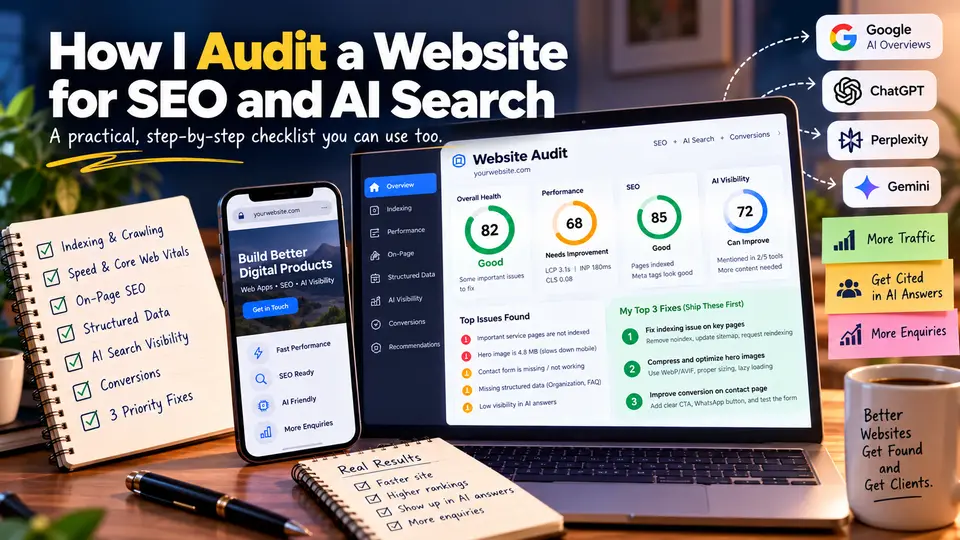
I offer a free visibility audit: send me your URL and I'll reply with a one-page read on your technical SEO health, how you currently appear in AI answers, and the three fixes I'd ship first.
More from the blog
More on the same themes as this post.
What I Check in a Free Website Audit (and the 3 Fixes That Matter Most)
Angular Prerendering in Production: 5 Bugs That Only Showed Up Live